Kraftwerk are among the most influential groups in the history of electronic music. Formed in Düsseldorf in 1970 by Ralf Hütter and Florian Schneider, the German band turned synthesizers, electronic percussion, processed voices, repetition and modern technology into a musical and visual language that reached far beyond experimental rock. Their records helped shape synth-pop, electro, hip-hop and, through Detroit’s own artists, techno.
The crucial distinction is that Kraftwerk did not invent Detroit techno. Artists including Juan Atkins, Derrick May, Kevin Saunderson and their Detroit contemporaries created that music from a distinctive combination of electronic sounds, funk, local radio, club culture and their own experiments. Kraftwerk were one important influence in that mix. Understanding that exchange is more interesting than declaring one band the inventor of every electronic genre that followed.
This is Underground Talent’s researched guide to Kraftwerk’s origins, core members, albums, instruments, influence and essential listening. It also explains why their famous eight-album retrospective begins with Autobahn, even though they had released three albums before it.
Editorial update: 31 October 2026. Album chronology was checked against the Museum of Modern Art, AllMusic and MusicBrainz; Detroit connections against the Detroit Historical Society; selected technical details against contemporary production research and specialist reporting. Earlier unsourced claims about who used a synthesizer or computer “first” have been removed.
Kraftwerk at a glance
| Question | Answer |
|---|---|
| Where did Kraftwerk form? | Düsseldorf, West Germany, in 1970. |
| Who founded the band? | Ralf Hütter and Florian Schneider, following earlier work in the experimental group Organisation. |
| What does the name mean? | Kraftwerk means “power plant” in German. |
| What were they known for? | Minimal electronic arrangements, sequenced rhythms, vocoders and synthetic voices, conceptual albums, and carefully coordinated visual performances. |
| Which album was the breakthrough? | Autobahn (1974), their fourth studio album, brought international attention. |
| What was the classic quartet? | Hütter, Schneider, Wolfgang Flür and Karl Bartos, associated with the late-1970s and early-1980s records. |
| What is their connection to techno? | Their electronic records influenced Detroit artists, but Detroit techno was created within Detroit’s own musical and social networks. |
| Are they in the Rock & Roll Hall of Fame? | Yes. Kraftwerk were inducted in 2021 for their musical influence. |
Where did Kraftwerk come from?
Düsseldorf, Organisation and the early experimental years, 1970–1973
Ralf Hütter and Florian Schneider met in the experimental musical environment around Düsseldorf in the late 1960s. They worked in Organisation, a short-lived group whose album Tone Float appeared in 1970, before founding Kraftwerk that year. The new name pointed toward the industrial modernity of their surroundings, but their earliest music did not yet sound like the precise electronic pop for which they are best known.
The first three Kraftwerk albums were Kraftwerk (1970), Kraftwerk 2 (1972) and Ralf und Florian (1973). Flutes, keyboards, guitars, percussion, tape techniques and increasingly electronic devices appeared as the musicians searched for a sound of their own. Different players moved through the early lineups, including musicians later associated with Neu!. The records sit within the broad West German experimental-rock landscape sometimes called krautrock, a label that is convenient but too blunt to explain the individual artists.
Producer and engineer Conny Plank was an important collaborator during the formative period. His approach to the studio helped enable the band’s search for texture and structure. Hütter and Schneider also established Kling Klang in Düsseldorf, developing a working environment in which instruments, recording techniques and visual ideas could be treated as parts of one project. Hi-Fi News’ production history of Autobahn documents their studio setup, Plank’s role and the customised equipment around the breakthrough recording.
The often-told story that Kraftwerk emerged fully formed as four uniformed men behind synthesizers is therefore wrong. The orderly machine aesthetic was the result of several years of changes in personnel, equipment, songwriting and artistic direction.
Why Autobahn changed their trajectory
By 1974, the band had brought those experiments into a more recognisable identity. Autobahn suggested a journey along a German motorway with motor-like rhythms, instrumental passages and a memorable sung theme. The album’s extended title composition was not conventional pop, but an edited single found a much wider audience. Its significance was not that electronic instruments had never appeared on records before; they had. Kraftwerk made an unusual, highly controlled and conceptually unified electronic record accessible beyond specialist experimental circles.
Autobahn was Kraftwerk’s fourth studio album, not their debut. When modern compilations or museum programmes begin there, they are selecting the start of the band’s best-known conceptual electronic catalogue, not rewriting the existence of the three earlier albums.
Who were the members of Kraftwerk?
Ralf Hütter and Florian Schneider
Ralf Hütter was a co-founder, composer, performer and central force behind Kraftwerk’s musical and visual direction. Florian Schneider was the other co-founder, associated with flute and early acoustic experiments as well as electronic timbres, custom instruments and processed voices. The partnership was fundamental to the band’s shift from experimental instrumental music to the recognisable Kraftwerk identity.
Schneider left the group in 2008, with his departure made public in early 2009. He died on 21 April 2020. The band’s history should therefore not describe him as a present-day touring member or suggest the original duo remained continuously active together. The Guardian’s Schneider obituary traces his early instrumental work, later technology interests and departure.
Wolfgang Flür, Karl Bartos and the wider creative team
Wolfgang Flür became associated with Kraftwerk’s electronic percussion and their classic stage image. Karl Bartos, who joined in the mid-1970s, contributed to rhythms, composition and performance during the band’s hugely influential late-1970s and 1980s period. Describing everything that happened as the work of two founders alone would erase important contributions.
Other musicians and collaborators also shaped particular records and performances. Visual artist and lyricist Emil Schult was especially important to the identity of the classic era, linking the band’s records to the visual language of transport, technology, machines and modern European life. Engineer Conny Plank’s earlier contributions mattered, too. Personnel and production credits need to be considered album by album rather than collapsed into a single permanent lineup.
The Rock & Roll Hall of Fame’s Kraftwerk induction honours Hütter, Schneider, Flür and Bartos, reflecting the lasting importance of the recognised quartet without implying that other collaborators were irrelevant.
Kraftwerk albums in chronological order
The easiest way to follow the development is to separate the early experimental records from the later, more tightly conceptual albums. The English titles below are used for ease of reading; several records also have original German titles or different names in later editions.
| Year | Album | Why it matters |
|---|---|---|
| 1970 | Kraftwerk | Early experimental instrumental work, not yet the familiar electronic pop sound. |
| 1972 | Kraftwerk 2 | More tape and instrumental experiments following personnel changes. |
| 1973 | Ralf und Florian | A transitional record toward electronic instrumentation and a more distinct identity. |
| 1974 | Autobahn | International breakthrough built around a coherent motorway concept. |
| 1975 | Radio-Activity / Radio-Aktivität | Radio communication and nuclear energy explored through increasingly synthetic sound. |
| 1977 | Trans-Europe Express / Trans Europa Express | Rail travel, identity and elegant, mechanised rhythmic design. |
| 1978 | The Man-Machine / Die Mensch-Maschine | Robotics, melody and the group’s defining human-machine visual identity. |
| 1981 | Computer World / Computerwelt | Computers, networks and programmed rhythm in concise electronic songs. |
| 1986 | Electric Café, later presented as Techno Pop | An evolving mid-1980s digital-era direction; releases and editions use different titles. |
| 1991 | The Mix | New studio reworkings of earlier compositions, not an album of entirely new songs. |
| 2003 | Tour de France Soundtracks | A later studio work focused on cycling, endurance and movement. |
Sources: MoMA’s chronological eight-album retrospective, AllMusic discography and MusicBrainz release history. The official retrospective represents eight major conceptual works from 1974 through 2003, including the reworked The Mix; it does not include the band’s first three studio albums.
The essential Kraftwerk albums, and what to listen for
Autobahn (1974): making a modern journey musical
Autobahn is more than a novelty imitation of traffic. Its extended title piece uses repetition and gradual change to give the sensation of travelling. The electronic material sits alongside instruments and studio effects, making the record a link between the early experimental era and the cleaner compositions of the next decade. Listen to the original album-length title track, not only the much shorter single edit, to hear the way its sections develop.
The title’s melodic clarity helped the music communicate outside specialist experimental circles, while its length and structure showed that an electronic composition need not behave like a three-minute pop song. That sense of movement through a repeated framework later became familiar to dance-music listeners, although the production and tempo are not simply a 1990s techno template.
Radio-Activity (1975): a concept with two meanings
The original title plays on radio broadcasting and radioactivity. The album’s sparse voices, electronic tones and small melodies sound very different from a rock band’s conventional stage arrangement. That ambiguity between communication and nuclear technology later became more explicitly political in concert versions of the title song. Avoid describing every recording or edition as though it contained exactly the same message.
Production-wise, the contrast between silence, small electronic figures and processed vocals is central. There is space around the sounds. Much of the music’s character comes from what Kraftwerk do not add.
Trans-Europe Express (1977): rhythm as movement
Trains provide the obvious theme, but the more important idea is motion. The tightly repeated pulse in the title composition and the linked instrumental passages creates a feeling of travel that also works on a dancefloor. Compared with the loosely experimental first albums, the arrangement sounds deliberate down to each recurring accent.
This album became a major point of connection with electro and hip-hop. The specific melody and rhythm of Trans-Europe Express reached new audiences through records that developed their own identities. It is an example of how an idea can move between communities without the resulting styles being reducible to one source.
The Man-Machine (1978): electronic pop with an image to match
The Man-Machine contains The Robots, Spacelab, Neon Lights and The Model, combining sharply defined synthesizer parts with exceptionally memorable melodies. The famous red-shirt imagery helped establish the idea of the musicians as both people and stylised machines. The stage image is not incidental decoration: it draws attention to the relationship between performer, technology and audience.
The Model later became a UK number-one single in February 1982, after its 1978 album release. Official Charts records the single’s combined The Model / Computer Love chart history; it was one UK number-one single, not two unrelated number-one songs.
Computer World (1981): before the networked world felt ordinary
Released in 1981, Computer World explores computers, numbers, communication and electronic life. The title composition, Numbers, Pocket Calculator, Computer Love and Home Computer demonstrate how a small number of repeated elements can become musical hooks. Human-sounding melodies coexist with patterns that appear rigid or machine-generated.
The album’s prophetic quality is easy to overstate. It imagined a world already beginning to take shape, and its subject matter proved lasting; that does not mean every sound was literally rendered by a contemporary general-purpose computer. The instruments and studio processes were a mixture of hardware, customisation, electronics and recording techniques. The artistic decision to sound computational is not the same claim as the technical means of production.
Electric Café / Techno Pop (1986): a change of pace
The 1986 release originally appeared as Electric Café. Later versions of the catalogue have used Techno Pop, a name also associated with the project’s development. That title history is why a museum programme or streaming catalogue may appear to disagree with an original LP sleeve without referring to a completely separate album.
Musique Non Stop captures a sleek, increasingly digital aesthetic. The changes from the late-1970s records can be heard in the production, but presenting the record as the single event that “invented techno” would confuse its title with Detroit’s own musical history.
The Mix (1991) and Tour de France Soundtracks (2003)
The Mix reimagined earlier Kraftwerk songs with contemporary production and arrangement choices. That makes it an album of important re-recorded and remixed material, but not a fresh collection of unrelated compositions. It shows how old ideas can be rebuilt for a changing musical and technological environment.
Tour de France Soundtracks (2003) returned to the group’s interest in movement, bodies and machines through cycling. Its relationship to the earlier Tour de France single of 1983 is important: the 2003 album is not simply the original 1983 song repackaged. It remains the band’s last studio album of principally new material in the conventional discography as of this update.
How Kraftwerk made electronic music sound different
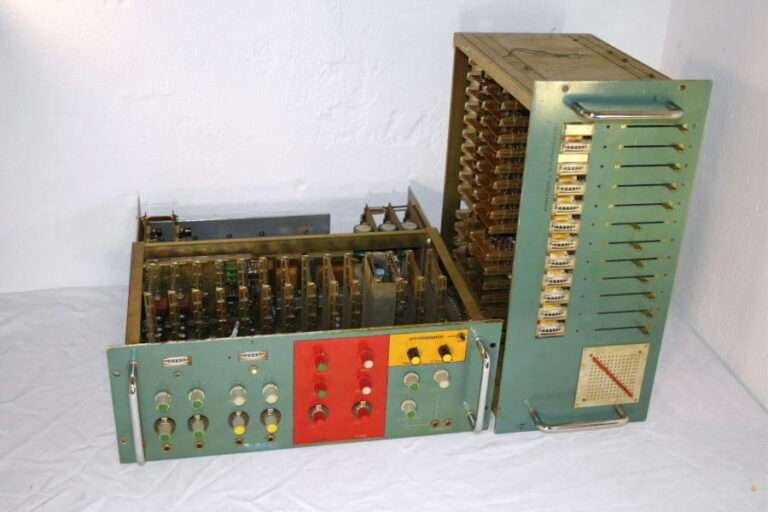
Synthesizers and deliberate sonic limits
What made the band’s records distinctive was not simply the possession of expensive electronics. Their arrangements often assigned individual musical tasks to a small number of clearly differentiated sounds: an insistent bass figure, a bright melodic shape, a percussive pattern and a synthetic voice. Each part has an identity. That gives the listener space to hear small changes.
Period equipment included Minimoog and ARP Odyssey synthesizers, with early studio experiments and engineering assistance documented around Autobahn. Instruments were modified, systems were combined and new devices were devised when the available tools did not quite do what the musicians wanted. Production accounts of the Kling Klang and Conny Plank sessions make this a more grounded story than claiming Kraftwerk were the first musicians ever to use a synthesizer.
Electronic percussion and the power of sequence
The band’s electronic percussion and programmed rhythms gave their later records a characteristic precision. Wolfgang Flür was associated with the use of custom electronic pads, while sequenced elements and repeated patterns allowed music to evolve through small variations. A drum machine or sequencer does not automatically make a compelling track; rhythmic spacing, arrangement and timbre still determine the result.
In Numbers, for example, the interplay of spoken digits and a driving rhythm is a lesson in economy. This idea later travelled through electro and techno, but there is no need to credit Kraftwerk with inventing all electronic percussion. Their achievement was to make such elements integral to a recognisable and widely influential body of songs.
Vocoder voices, speech and the human-machine tension
Florian Schneider’s interest in changing the human voice was one distinctive part of Kraftwerk’s identity. Vocoders and related speech-processing techniques made words sound synthetic, while simple melodies kept the results unexpectedly emotional. Later robot imagery pushed the same contrast into the stage show: a person seems to withdraw behind an image of automation, yet the music is still an artistic decision made by humans.
When producing techno or electro today, it is worth asking what the processing does musically. A robotic vocal can supply rhythm, a memorable phrase or an atmosphere of distance. Using a plug-in preset that sounds like a vocoder is not, by itself, an artistic concept.
Kling Klang, repetition and the studio as an instrument
Kraftwerk’s controlled studio practice helped them construct an entire aesthetic around their material. Tape manipulation, hardware experimentation and methodical refinement were part of the early process. The later songs often sound almost effortless, but the apparent simplicity is built on choices about which notes, sounds and words to leave in the arrangement.
The Museum of Modern Art’s 2012 retrospective describes Kraftwerk’s integration of audio, visuals, robotics and performance. That provides a useful way to understand the project: not technology for its own sake, but technology organised into a coherent musical world.
How did Kraftwerk influence Detroit techno?
The connection runs through records heard by young Detroit musicians, not a direct transfer of ownership over a genre. Detroit radio personality the Electrifying Mojo played a famously wide selection of music, including Parliament-Funkadelic, Prince and Kraftwerk. Juan Atkins and other young listeners absorbed those electronic sounds in the context of their own musical lives.
According to the Detroit Historical Society’s Juan Atkins biography, Atkins drew on George Clinton as well as Kraftwerk, developed early music with Rick Davis as Cybotron, and later recorded as Model 500 and founded Metroplex. The same historical institution’s profile of the Electrifying Mojo explains the broadcaster’s role in bringing unusual music to Detroit audiences and then supporting the local music that emerged.
It is therefore accurate to say that Kraftwerk influenced Detroit techno’s pioneers. It is not accurate to say that Kraftwerk were a Detroit techno group, that the genre was imported fully formed from Germany, or that early techno was made by simply copying a Kraftwerk rhythm. Black American artists in Detroit combined electronic music with funk, electro, local dancefloors and their own production ideas to build something new. If you want the detailed profiles and recordings, see Underground Talent’s 30 techno pioneers who shaped the genre.
Kraftwerk’s impact also extended into the sound of electro. Afrika Bambaataa and the Soulsonic Force’s Planet Rock (1982) famously drew on Trans-Europe Express and Numbers. The MusicBrainz credits for the 1982 recording identify both Kraftwerk sources, and MoMA highlighted the connection in its hip-hop programming. What resulted was not a German track renamed, but a distinctive New York electro and hip-hop record made by its own creators.
That circulation of ideas is the real historical significance: music produced in Düsseldorf moved through American radio, clubs and record shops, then was transformed in new social settings. It connects generations without erasing who created the later styles.
Kraftwerk’s influence beyond techno
Synth-pop and the place of electronics in popular songs
By turning synthesizer melodies, electronic rhythms and processed voices into accessible songs, Kraftwerk helped make a new kind of pop imaginable. Their influence can be heard across the wider history of synth-pop and electronic production, even when later artists took the aesthetic in warmer, noisier or more conventional directions. It is not necessary to claim that every synth-pop group copied a single Kraftwerk record; the important point is the expansion of possibilities for popular songwriting.
Hip-hop, electro and the musical life of a sample
The route through Planet Rock is one of the clearest and best-documented examples. A Kraftwerk rhythm and melody became material for another influential electronic dance record. Samples, interpolations and rhythmic reinterpretations need to be distinguished carefully: sampling is not the same as an artist using a similar production principle, and influence is not the same as ownership of a genre.
Techno, house and later electronic dance music
Minimal arrangements, repeated figures, synthesizer basslines and the notion of a track developing without a conventional rock-song structure were useful to later dance-music producers. But house grew from particular Chicago dance-music communities, and techno developed in Detroit. Both have multiple roots. For how these later styles differ in sound and history, see our guide to techno subgenres.
Visual art and performances built around an idea
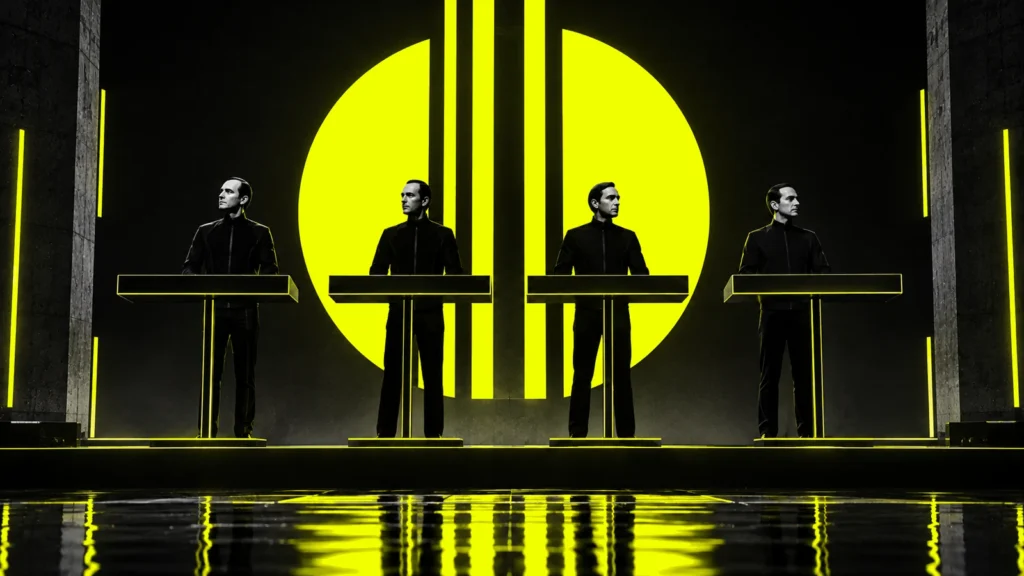
The band’s red shirts, geometric graphics, robots, transport imagery and spare stage arrangement formed an identity as deliberate as the music. Kraftwerk’s modern concerts brought carefully synchronised projection and 3-D visualisations into the same space as the recordings, extending themes established decades earlier.

In April 2012, the Museum of Modern Art in New York presented Retrospective 1 2 3 4 5 6 7 8, eight concerts across eight consecutive nights exploring their selected major albums and live visual language. The programme was an artistic retrospective, not proof that Kraftwerk made only eight albums or that they never had earlier experimental recordings.
Their later institutional recognition included a 2018 Grammy Award for Best Dance/Electronic Album for 3-D The Catalogue and 2021 induction into the Rock & Roll Hall of Fame in recognition of their influence. These dates can be checked against the Recording Academy’s Kraftwerk profile and the Hall of Fame entry. Awards confirm recognition, but the more enduring measure is how much their musical language continued to change other people’s work.
Where to start listening: eight essential Kraftwerk tracks
If you have never listened beyond the most familiar singles, this short sequence follows the development of the sound rather than claiming to rank every composition. Use the original album recordings when available; later live versions and retrospective recordings may differ considerably.
- Autobahn (1974): start with the album-length composition and hear an evolving journey through small musical scenes.
- Radioactivity (1975): pay attention to fragile electronic tones, silence, melody and the layered subject of radio and nuclear energy.
- Trans-Europe Express (1977): notice the precise rhythmic travel motif and the controlled accumulation of texture.
- The Robots (1978): listen for the relationship between stylised synthetic voices, melody and mechanical rhythm.
- The Model (1978): hear how an economical electronic arrangement can function as a memorable pop song.
- Numbers (1981): focus on percussion and the rhythmic role of spoken counting; compare it with the electro music it later influenced.
- Computer Love (1981): listen to the human emotional quality of a very controlled electronic melody.
- Tour de France (1983, single): trace the theme of physical movement and rhythmic cycles, then explore the broader 2003 Tour de France Soundtracks album.
For a deeper path, add Neon Lights, Pocket Calculator, Home Computer, Musique Non Stop and selected versions from The Mix. The point is to notice both continuity and change. The band’s influence is often clearest in the details of timing, timbre and arrangement rather than in a single spectacular synthesizer sound.
Four common myths about Kraftwerk
Myth 1: Kraftwerk invented electronic music
Electronic and electroacoustic music existed well before the band formed. Kraftwerk’s historical importance lies in their influential treatment of electronic sound within repeatable, concept-driven compositions and international popular music. Calling them pioneers is justified; calling them the sole inventors erases an extensive earlier history.
Myth 2: Kraftwerk invented Detroit techno
They were an important influence, but Detroit’s artists created techno within their own musical community. The Detroit Historical Society’s documentation of Juan Atkins and the Electrifying Mojo explains that influence alongside funk, radio and local production.
Myth 3: Autobahn was their first album
It was their fourth. The previous three albums date to 1970, 1972 and 1973. The well-known eight-album museum sequence starts at Autobahn because it presents a particular retrospective of the developed electronic catalogue.
Myth 4: Every Kraftwerk sound was made by a computer
Not so. Their recordings span an evolving mixture of tape, modified instruments, analog synthesizers, electronic percussion, voice processors, sequencers and later digital technologies. Computer World is a conceptual album about computing and modern life; its title is not a technical production log.
What electronic music producers can learn from Kraftwerk
There is more to learn here than buying a vintage synth or emulating a robot voice. Kraftwerk show how a coherent artistic idea can guide writing, sound design, performance and visual presentation.
- Keep individual parts legible. Build a short sequence from a limited set of sounds: a bass figure, a percussive pulse, a melodic shape and one counterpoint. Remove anything that masks the central idea.
- Let repetition develop. Rather than adding a new element every four bars, change timbre, rhythm, spacing or articulation over a longer phrase. Repetition is a surface on which variation can become audible.
- Treat the voice as sound. Experiment with vocoding, speech synthesis or filtering in a way that supports the concept, rather than applying a recognisable effect merely for its novelty.
- Use constraints deliberately. A small palette of instruments can make a track more identifiable, provided the arrangement actually uses the sounds well. Unlimited plug-ins are not an artistic direction.
- Connect the music to an idea. A track about travel, communication or movement can have sonic decisions that reinforce that theme, even without lyrics explaining it.
- Study influence without erasing origin. Learn the music’s routes through Detroit, electro and other scenes, and give the people who transformed those ideas their own historical agency.
If you want to go beyond Kraftwerk’s specific catalogue, our nine recommended books on electronic music, techno and rave offer longer accounts of Detroit, Berlin, British bass and related histories. Our techno party culture guide takes those records into the social space of the dancefloor.
Kraftwerk: frequently asked questions
Who founded Kraftwerk?
Ralf Hütter and Florian Schneider formed Kraftwerk in Düsseldorf in 1970 after working together in Organisation. The band’s early lineups changed before the classic late-1970s quartet became established.
What genre is Kraftwerk?
They are generally described as an influential electronic group whose music moved from experimental rock toward electronic pop. Their work became important to synth-pop, electro and techno, but it is historically misleading to classify their entire catalogue as Detroit techno.
Why is Kraftwerk so important?
They brought together electronic instrumentation, repeated rhythms, simple melodies, processed voices, album concepts and distinctive imagery in recordings that reached a large international audience. Their work was widely heard, covered and reused by later musicians in different genres.
What was Kraftwerk’s first album?
The self-titled Kraftwerk album appeared in 1970. Kraftwerk 2 followed in 1972 and Ralf und Florian in 1973, before their international breakthrough with Autobahn in 1974.
Which Kraftwerk album influenced techno the most?
There is no definitive single answer, but Trans-Europe Express, The Man-Machine and Computer World all contain elements that reached electro and techno audiences. The historical route matters: artists in Detroit and elsewhere transformed these influences rather than reproducing an album unchanged.
Did Kraftwerk use drum machines and synthesizers?
Yes. Their evolving studio and live systems used synthesizers, electronic percussion, modified or custom-built devices, sequencers and voice-processing equipment. The exact equipment and recording method vary across their decades of work.
Is Florian Schneider still in Kraftwerk?
No. Co-founder Florian Schneider left in 2008, and his death on 21 April 2020 was reported that May. Ralf Hütter continued the Kraftwerk project after Schneider’s departure.
How many albums did Kraftwerk release?
The band’s catalogue includes three early studio albums before Autobahn, followed by later conceptual studio albums, remixes and live releases. The famous eight-album 1 2 3 4 5 6 7 8 retrospective is a selected sequence from 1974 to 2003 and should not be mistaken for a complete count of all their releases.
What is the difference between Electric Café and Techno Pop?
Electric Café is the title under which Kraftwerk’s 1986 album originally appeared; Techno Pop is the title used for that material in parts of the later catalogue. They are related presentations of the same album, not two separate releases of new studio compositions in 1986.
Did Kraftwerk win a Grammy?
Yes. 3-D The Catalogue won Best Dance/Electronic Album at the 2018 Grammy Awards. The group was also inducted into the Rock & Roll Hall of Fame in 2021.
Research sources and further listening
The most important historical claims above were checked against the following sources rather than inferred from unsourced artist lists:
- Museum of Modern Art: Kraftwerk, Retrospective 1 2 3 4 5 6 7 8 (2012), for the selected album timeline and the group’s sound-and-visual concept.
- AllMusic: Kraftwerk discography and MusicBrainz, for early albums, alternative titles and release history.
- Detroit Historical Society: Juan Atkins and the Electrifying Mojo, for documented Detroit musical connections.
- Hi-Fi News: Autobahn production notes, for Kling Klang, Conny Plank, custom electronic percussion and period synthesizers.
- Official Charts: The Model / Computer Love, for the February 1982 UK number-one chart entry.
- The Guardian: Florian Schneider obituary, for the timeline of his role, departure and death.
- Recording Academy: Kraftwerk awards and Rock & Roll Hall of Fame, for the 2018 and 2021 recognitions.
Kraftwerk’s enduring lesson is not that machines replaced musicians. It is that a few chosen sounds, a strong concept and patient technical experimentation can become a musical language that artists in very different cities and generations make their own.