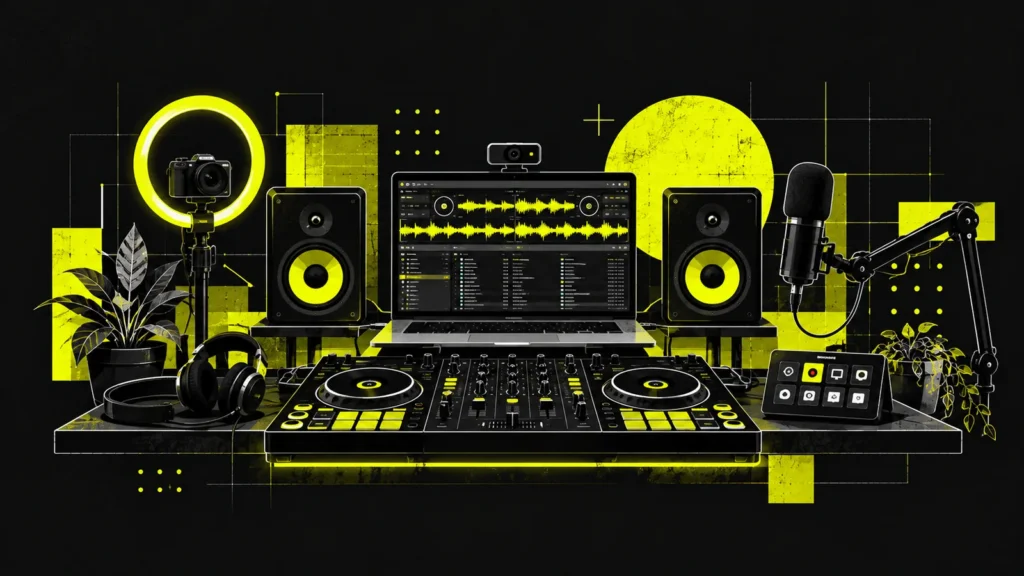
You can livestream a DJ set from home with a DJ controller or mixer, a computer, a reliable audio connection and free streaming software such as OBS Studio. A webcam or phone camera and a simple light are useful, but the most important thing is getting clean audio from your mixer to the broadcast without clipping, feedback or accidental silence.
This guide explains how to connect the equipment, set up OBS, choose a streaming platform in 2026, test your connection and troubleshoot the problems that can ruin a set. It also covers something that gear tutorials often overlook: music-streaming rights. Buying or downloading a track does not automatically give you permission to broadcast it on every platform.
Whether you’re planning an intimate techno session, a vinyl-only stream or a weekly house show, start with the smallest reliable setup. You can add multiple cameras, overlays and lighting effects after the audio is working.
DJ livestream setup: the quick checklist
| Essential | Useful upgrade | Wait until needed |
|---|---|---|
| Working DJ decks/controller and headphones | Dedicated audio interface or mixer USB stream output | Expensive broadcast mixer |
| Computer that can run DJ and streaming software reliably | Separate computer for streaming demanding sets | Second PC for a basic stream |
| Clear stereo route from DJ mixer to streaming software | Camera or webcam, stable mounting, one soft light | Multiple cinema cameras |
| Stable upload connection, preferably wired | Microphone for talking to viewers | Custom animated graphics |
| Platform account and music-use permissions | Moderator, test channel and a backup connection | Simultaneous broadcast to every platform |
Fast route: DJ mixer/controller output → suitable computer audio input or USB interface → OBS audio source → chosen platform. Camera and microphone are separate OBS sources. Monitor the actual streamed output, not only what your headphones hear.
1. Choose how to get audio from your DJ mixer into the stream
The audience needs the same coherent mix that you hear at the master output. There are three common ways to route it, and they are not interchangeable on every model of DJ gear.
Option A: Your DJ controller already works as a USB audio interface
Some controllers and digital mixers can send their master output to the computer over USB. This may be the simplest route, but a USB connection alone does not guarantee that OBS receives the mixed master signal. Depending on the model and driver, the USB channels might carry individual decks or only playback from DJ software.
Check your controller’s audio-routing documentation. In OBS, add an appropriate Audio Input Capture source or another supported audio-capture source, select the device and test whether the meters move when the mixer plays. Confirm both decks, the crossfader and your microphone reach the intended output.
Option B: Use a separate audio interface
If your mixer has a stereo REC OUT, BOOTH OUT or appropriate line-level MASTER OUT, you can connect it to two line inputs on an audio interface. Match the connectors and signal level to the equipment rather than assuming every XLR, RCA or ¼-inch socket accepts the same signal.
Typical chain: mixer stereo line output → left/right line inputs of audio interface → USB to computer → stereo source in OBS → livestream.
A recording output with a fixed level is often convenient because changes to the booth-monitor volume do not necessarily change the broadcast level. Avoid putting a strong line signal into a microphone-only input or treating a headphone jack as a normal line output without understanding the level and connectors. Both mistakes can lead to distortion.
Option C: DJ and stream from the same computer
A software-only DJ setup may be able to route its master output into OBS through supported loopback, device routing or virtual audio software. The available method depends on the operating system, DJ application, driver and soundcard. On some systems it is straightforward; on others, a dedicated interface is simpler and more stable.
Be particularly careful with monitoring loops: if OBS captures a signal that contains the stream’s own monitoring return, you may hear an echo or create feedback. Start with just one audio path into the stream and add more only after testing.
2. Set levels correctly before going live
Good broadcast audio matters more than a high-end camera. A DJ set is a continuous signal, and streaming encoders can make distorted or overly limited material sound unpleasant even when the picture is excellent.
- Play a loud section from the kind of tracks you expect to mix.
- Set individual deck gains and your DJ mixer’s meters appropriately; avoid clipping at the deck, channel and master stages.
- Adjust the interface input so the digital stream retains headroom. As a cautious test target, look for healthy OBS meters with musical peaks often around −12 to −6 dBFS, rather than constantly touching 0 dBFS. This is an illustrative starting range, not a platform loudness standard.
- Listen through headphones to the output recorded or received by your streaming software, not only the direct DJ-monitor feed.
- Test a quiet track, a loud track and the transition between them. Make sure the music doesn’t disappear when you cue the next deck.
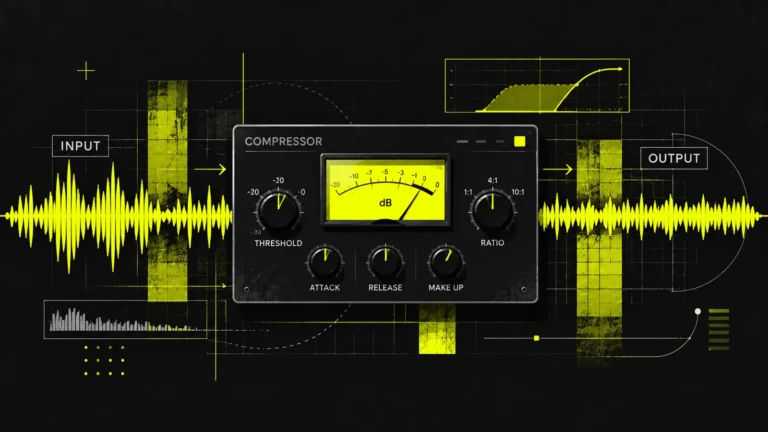
If the stream clips while your DJ mixer appears clean, check the interface input gain and any extra gain inside OBS. If the stream is too quiet, inspect each stage separately instead of turning everything up blindly. Resist heavy limiting on the broadcast unless you can identify why it is needed. Our audio compression guide explains gain reduction and level matching in detail.
3. Camera, lighting and room setup
A single well-positioned camera is enough for a convincing home DJ broadcast. Choose an angle that clearly shows the DJ, decks and hands. Mount the camera securely, keep stands away from moving arms and cables, and check that the shot works on a phone screen.
- Camera: A supported webcam, smartphone used through a reliable camera app or HDMI camera with a capture device can work. Check power, capture compatibility and heat for long streams.
- Lighting: One diffused key light illuminating your face or hands is more useful than a dark room full of flashing LEDs. Avoid shining bright lights directly into the camera.
- Background: Keep it intentional but not overcrowded. A few records, acoustic panels or simple lighting can establish atmosphere without hiding the performance.
- Microphone: If you plan to speak, choose a mic you can mute quickly. Route it through a separate OBS source when practical so you can adjust speech and music independently.
- Safety: Secure cables, keep liquids away from power and audio equipment, and leave ventilation around computers and interfaces.
Room treatment can improve microphone sound, but soundproofing is a different task. You do not need to rebuild the room before streaming a direct feed from your mixer. If neighbours are a concern, mix in headphones rather than assuming acoustic foam stops sound travelling outside.
4. Which streaming platform is best for DJs in 2026?
There is no universal answer because music-rights coverage, monetization, replay restrictions and audiences differ. These policies can change. Before planning a set, read the platform’s current terms and confirm that the specific recordings you intend to play are permitted in the way you intend to use them.
| Platform | Why DJs consider it | Important rights and workflow limits |
|---|---|---|
| Twitch DJ Program | Live chat, discovery within its DJ community and a licensed DJ Music Catalog for enrolled broadcasters | Use only catalog-authorized tracks or music for which you have the required separate rights. DJ Program earnings sharing applies to monetizing DJs. Music-containing VODs, Highlights and normal uploads are restricted, and DJ clips cannot contain catalog music. |
| Mixcloud Live | Licensed, DJ-focused music streaming with a dedicated live audience | Mixcloud Pro is required to broadcast. Its licensing and terms govern eligible content, and it does not save live video for general replay. Check its current rules before assuming every track or video element is covered. |
| YouTube Live | Searchable channel, broad audience and familiar streaming infrastructure | Live streams are checked for third-party content. Music matches can interrupt or terminate broadcasts. Permission and Content ID allowlisting may be necessary even where you hold a license. |
| Other social platforms | Existing followers and easy mobile discovery | Live music and recorded-replay rights vary. Do not assume a platform’s short-video music library also covers a full-length DJ livestream. |
Twitch DJ Program: understand the music catalog
The official Twitch DJ Program FAQ explains that enrolled DJs can livestream tracks marked as permitted in the DJ Music Catalog under Twitch’s agreements. The catalog is a search reference, not a source of audio files. You still play music through your own hardware or software.
Check each planned track in the catalog. Releases that are missing, restricted or not marked as allowed are not automatically covered. Pre-release or unreleased recordings have additional restrictions. The program also involves sharing a portion of channel earnings with rights holders when monetizing, and it limits normal video-on-demand features for DJ content. You should not plan your entire social-media strategy around saving complete Twitch DJ set VODs.
Mixcloud Live: licensed, but not unlimited
Mixcloud states that Mixcloud Live operates under agreements with music rights holders. It requires a Mixcloud Pro account and RTMP-compatible streaming software. The platform may make an audio-only recording available after a qualifying live show, but it does not preserve the broadcast video as a normal replay.
Its terms still apply, including rights over visual materials. Music licensing for the live platform is not blanket permission to upload the same video to another service afterward.
YouTube Live: check music rights before you start
YouTube says live streams are scanned for third-party copyrighted content. A detected match can trigger a warning, placeholder screen, interruption or termination. If you have licensed music, ask the owner about Content ID allowlisting where appropriate. This is particularly important for full DJ sets made of commercial recordings.
Buying a track on Beatport, Bandcamp or another store normally gives you a listening or performance-use copy, not automatic global audiovisual livestream rights. This guide is practical information, not a substitute for advice on a specific license or jurisdiction.
5. Set up OBS Studio for a DJ livestream, step by step
OBS Studio is free broadcasting software for major desktop platforms. Its official Quick Start Guide recommends beginning with the Auto-Configuration Wizard, setting up sources and making a test recording before broadcasting.
Step 1: Install OBS and run the Auto-Configuration Wizard
Install OBS from its official site, open Tools → Auto-Configuration Wizard and choose settings for streaming. Let it assess your hardware and network. You can fine-tune the result later, but start with the wizard rather than copying random encoder settings from another computer.
Step 2: Build a simple scene
Make a scene called DJ Live. Add a Video Capture Device for your camera, position it in the preview, and add any background or text you need. Keep logos and labels legible at a small phone size. If you use a second camera, verify that the additional capture does not overload your system.
Step 3: Capture the correct stereo audio input
Add the DJ mixer’s USB master or the dedicated interface as an audio source. If the signal is meant to be stereo, check that both left and right are arriving and that the stream isn’t unintentionally sending a mono channel or silence. In the audio mixer, mute any redundant desktop-audio or microphone source that would double the sound.
Open the Advanced Audio Properties only when necessary. Avoid enabling monitoring on multiple devices without understanding where the monitored sound is routed; that can create delayed echoes.
Step 4: Configure stream destination and output
In Settings → Stream, choose the supported service or enter its RTMP server details, then connect the account or paste the stream key provided by the platform. Keep your stream key private. Anyone with it may be able to broadcast to your channel.
Use an encoder supported by both your hardware and platform. Hardware H.264 encoding is often a practical, broadly compatible choice, but do not force a setting merely because it is fashionable. Review the destination’s current requirements for video codec, keyframe interval, bitrate, audio codec and maximum frame rate.
Step 5: Choose resolution, frame rate and bitrate for stability
A clear 720p at 30 fps stream may serve a home DJ performance better than unstable 1080p or 60 fps. Higher resolution increases bandwidth and encoding workload. A starting point is to test a moderate 720p30 preset supported by your platform, then increase quality only if the machine and connection remain stable.
The latest YouTube encoder guidance lists different bitrates depending on codec, resolution and frame rate; do not copy those numbers to Twitch or Mixcloud without checking their limits. Use a speed test to establish reliable upload capacity, not download speed, and leave substantial overhead for network fluctuations and audio traffic.
For music, avoid unnecessary audio processing and use the platform’s supported stereo audio codec and sample rate. A consistent 48 kHz path is common in video workflows, but the correct setting depends on the service and your equipment. YouTube, for example, publishes its own stereo audio recommendations.
Step 6: Record and inspect a full test
Make a local OBS recording before your first public set. Listen to it from start to finish on another device. Check music level, stereo image, mic balance, camera framing, synchronization and clipping. OBS recommends using a short test to find errors before streaming. If you plan a lengthy broadcast, test long enough to discover heat, USB disconnects or encoder overload.
Step 7: Test the actual stream privately where possible
Use a platform-supported private, unlisted or otherwise limited test method if available, without assuming it provides any exemption from copyright rules. Open the live feed from a different device on the viewer side, with the DJ monitor sound muted, so you can hear what the audience actually gets.
Start with an intentionally short first stream. Watch OBS’s dropped-frame and network status, and verify that the chat and sound continue during transitions.
6. Fix common DJ livestream problems
| Problem | Likely checks | First practical fix |
|---|---|---|
| Video is fine, but no music is heard | Wrong audio device, muted OBS source, mixer USB routing or silent channel | Verify mixer master reaches the intended OBS input and moves its meters |
| Distorted or harsh sound | Clipping at deck, mixer, interface input, OBS or output chain | Reduce level at the first overloaded stage and retest |
| Echo or doubled sound | Desktop audio plus interface capture, or monitoring loop | Disable duplicated inputs and unnecessary audio monitoring |
| Audio comes noticeably before/after video | Camera processing or capture/driver latency | Check sync offset with a clap test and adjust only the needed source |
| Stuttering video and dropped frames | Upload instability, CPU/GPU overload, high bitrate or Wi-Fi congestion | Use wired Ethernet, lower resolution/bitrate and retest |
| Only left or right channel is audible | Input mapping or single-channel capture | Check line inputs, cable routing and stereo source configuration |
| Broadcast removed for copyright | Track not covered by relevant streaming rights | Stop using unlicensed material; review the platform program and rights status |
7. Internet reliability and a practical backup plan
Use wired Ethernet when practical. Wi-Fi can work, but wireless congestion and variable signal strength may cause sudden dropped frames even when a speed test looks fast. Test at the same time of day you plan to stream, particularly if other people share the connection.
Before a longer set, close unnecessary downloads and cloud-sync tasks. Keep OBS’s statistics visible, prepare a fallback lower-bitrate profile, and make sure your devices have stable power. A mobile connection can serve as an emergency backup if your plan and coverage allow, but do not count on it without a real test.
Record your own camera or microphone material only where you have the necessary rights; having a local recording file does not grant permission to redistribute commercial tracks captured within it. If the platform’s DJ program prohibits saving its licensed music content as VODs, follow those limits.
8. Make the broadcast engaging without losing focus on the music
You don’t need a flashy overlay to keep an audience. Tell listeners what kind of set you’re playing, use a consistent show time, and make it easy to find the next event. A stable visual identity, readable camera angle and clean music often work better than a complicated screen.
- Before the show: Announce the date, time zone, platform and musical direction. Share one working link rather than asking followers to hunt for it.
- During the show: Welcome viewers when practical, keep transitions central, and provide track credits where permitted and feasible. If chat grows, consider a trusted moderator.
- After the show: Review your stream-health data and audience feedback. Share still images, a recap and any music-free or separately licensed clips that the platform allows.
If a label wants a premiere or an exclusive unreleased track, confirm the streaming permissions in writing. Twitch’s DJ Program has specific rules around prereleases even if a label is enthusiastic about promotion; do not assume a DM from the artist overrides platform restrictions.
For a broader career plan, read our guide to developing your DJ career. If you want to produce the music you’re performing, our electronic music production starter guide is a good next step.
Frequently asked questions about DJ livestreaming
Can I livestream a DJ set using only a controller and a laptop?
Often, yes. If the controller has a supported USB master-output path into the computer, OBS may capture it directly. If not, you may need an audio interface, loopback routing or a separate streaming computer. Test the actual master signal before buying more hardware.
Do I need a professional camera?
No. A reliable webcam or compatible smartphone can work well. Lighting, stable mounting and composition matter more than chasing the most expensive sensor.
Should I stream in 720p or 1080p?
Use the highest quality that remains consistently stable under your actual computer and upload conditions. A steady 720p30 stream is better than a 1080p broadcast that repeatedly stutters. Follow the destination’s supported bitrate guidelines.
Can I play copyrighted tracks in a DJ livestream?
Only when the applicable rights and platform terms allow that use. Twitch DJ Program participants can play tracks permitted in the program’s catalog; Mixcloud Live operates under its own licensing arrangements and terms. YouTube may interrupt copyrighted music. Buying a track, crediting the artist or turning monetization off does not by itself provide all necessary rights.
Is OBS Studio free for DJ livestreaming?
Yes. OBS Studio is free and open-source broadcasting software. Some hardware, additional applications or streaming services may have separate costs.
Why does my livestream sound worse than the mixer headphones?
Possible causes include a clipped interface input, unnecessary OBS gain, wrong channel mapping, low audio bitrate, audio-processing effects or monitoring the wrong signal. Make a recorded test and work through the chain one stage at a time.
Can I save and repost my full livestream?
Not automatically. Whether you can retain, publish or monetize a replay depends on the music licenses and the platform. Twitch’s DJ Program restricts normal DJ music VODs and music-containing clips, while Mixcloud does not offer standard saved video replays of Live sets. Separate permission may be needed for a video upload elsewhere.
How do I get viewers for my first DJ stream?
Pick a clear musical niche and a realistic schedule. Tell existing listeners where to tune in, announce the show before the event, publish permitted highlights or behind-the-scenes posts, and return regularly. Viewership develops through consistency, not just new equipment.
Final checklist before you press Go Live
- Check every planned track against your platform’s current music rules or separate permissions.
- Confirm the mixer master reaches the correct stereo input with clean headroom.
- Check your camera, lighting, microphone mute and monitoring.
- Test the actual streaming destination, upload stability and synchronized audio/video.
- Keep the stream key private and have a simple recovery plan for disconnects.
- Listen to a local recording and a viewer-side test, then start the show.
The best home DJ livestream is not the most expensive setup. It’s the one that delivers uninterrupted music, intelligible sound and an experience people want to return to.