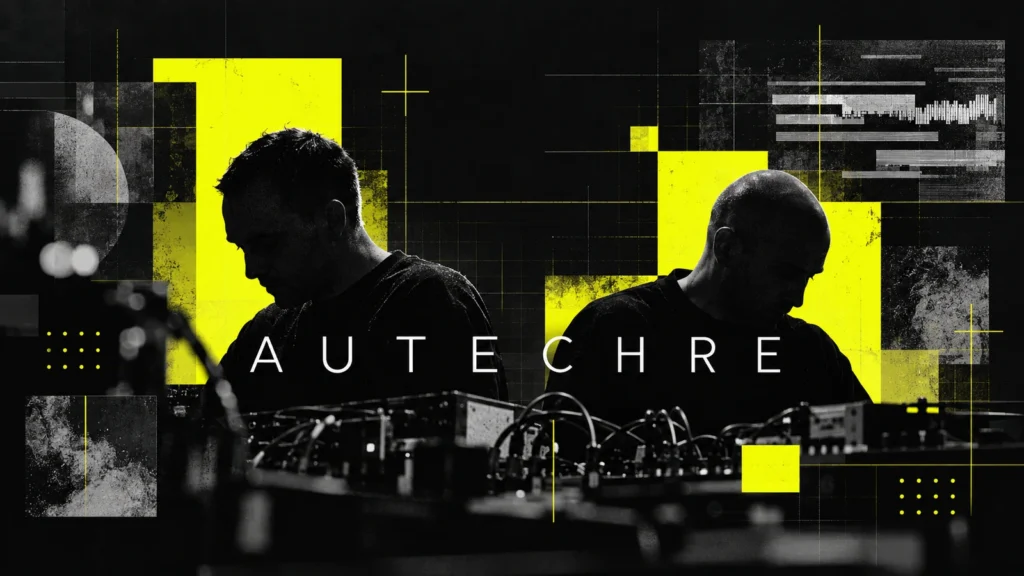
Autechre are an English electronic music duo made up of Sean Booth and Rob Brown, known for turning rhythm, synthesis and digital processes into some of the most distinctive experimental music of the past three decades. Their work began close to electro, hip-hop and early techno but evolved into shifting percussion, unusual timbres, intricate sequencing and compositions that rarely behave like conventional songs.
They are often grouped with the music that critics labelled intelligent dance music (IDM), yet that term tells you only a small part of the story. Autechre’s records can be melodic, abrasive, playful, sparse, rhythmic or almost impossible to predict. You can hear the transformation from their early 1990s Warp releases through Confield, Exai, the eight-hour NTS Sessions and the contrasting albums SIGN and PLUS.
This updated guide traces their story, explains how their music works, offers a practical beginner’s listening path and separates their recent live releases from studio albums. It includes information verified through Autechre’s official catalog, Warp/Bleep and documented interviews. Updated October 2026.
Who are Autechre?
Sean Booth and Rob Brown emerged from Rochdale, Greater Manchester, in the late 1980s, sharing an interest in electro, hip-hop, early sampling and electronic sound design. They found a home at Sheffield label Warp Records, whose early-1990s releases helped introduce a strand of electronic music designed for immersive listening as well as dancing.
Autechre appeared on Warp’s influential Artificial Intelligence compilation in 1992, and their debut album, Incunabula, followed in 1993. Their sound was not simply an escape from dance music: you can hear the influence of breakbeats, electro percussion and the physical pulse of clubs throughout their catalog, including in albums that seem highly abstract on first listen.
They are unusual in how consistently they have changed their process. Rather than treating a successful sound as a fixed identity, they have moved through hardware samplers, drum machines, intricate MIDI systems and extensive custom software. Their work with the visual programming environment Max/MSP became especially important to their ability to create and manipulate interconnected processes. In a detailed Sound On Sound interview, the duo explain how Max matched the interconnected way they already thought about hardware.
The name Autechre is often presented as a mystery to be decoded. In reality, the more revealing story lies in the music: a continuing experiment in how sounds can change, interact and surprise their creators.
What does Autechre sound like?
There is no single Autechre sound, but several recurring qualities help listeners recognize their work.
- Rhythm as composition: Percussion is not merely a beat under a melody. Timing, accent, density and the movement of individual hits often become the main musical idea.
- Mutating sound design: A sound may bend in pitch, change its envelope, gain new overtones or transform into something with a completely different texture.
- Unusual structures: Instead of predictable drops and choruses, parts appear, evolve, collide and disappear. Some pieces are tightly edited; others unfold over long stretches.
- A tension between machine and human: The sounds can feel generated by a system, yet the choices of pace, contrast, texture and repetition reveal strong musical judgment.
- Contrasting moods: Alongside abrasive, densely programmed tracks are delicate melodies, drifting atmospheres and moments of surprising warmth.
It is tempting to describe their work as “random” because of the irregular rhythms. That can miss the point. Autechre’s music often grows from controlled systems, carefully built instruments and decisions made while listening. The outcome may be difficult to anticipate without being arbitrary.
For context on the broader scene around their early records, see our guide to techno and its subgenres. Autechre do not sit neatly inside any one of those labels.
Autechre albums: how their sound evolved
The easiest way to understand Autechre is to follow several distinct periods. Their extensive discography contains many EPs, live recordings and extended projects, so the following is a selected listening map rather than an exhaustive release list.
| Album or project | Year | Why it matters |
|---|---|---|
| Incunabula | 1993 | Early electro- and techno-rooted grooves, atmosphere and recognisable melodic shapes |
| Amber | 1994 | Spacious, emotive, melodic textures that remain an approachable entry point |
| Tri Repetae | 1995 | Dryer, more mechanical rhythm patterns and increasingly unusual sound design |
| Chiastic Slide / LP5 | 1997 / 1998 | Detailed rhythmic architecture, sharper contrasts and complex digital textures |
| Confield | 2001 | A major move toward generative, fractured and less predictable structures |
| Draft 7.30 / Untilted | 2003 / 2005 | Dense, restless sequencing and strong rhythmic experimentation |
| Quaristice / Oversteps | 2008 / 2010 | Two different approaches, from short shifting sketches to more prominent melodic colour |
| Exai | 2013 | An expansive double-length statement with both forceful grooves and abstraction |
| elseq 1–5 | 2016 | Long-form digital-first music, spanning intricate percussion and slowly changing textures |
| NTS Sessions 1–4 | 2018 | An approximately eight-hour collection, originally presented through four NTS broadcasts |
| SIGN / PLUS | 2020 | Companion-era albums with different balances of atmosphere, melody and rhythm |
Album dates and release histories are cross-checked with MusicBrainz, the Warp/Bleep catalog and Autechre’s catalog.
Early Autechre: Incunabula, Amber and Tri Repetae
Incunabula still resembles music a listener coming from electro or Detroit techno might recognize. There are clear rhythmic loops, basslines and motifs, even as the sound palette develops its own character. Amber leans into expansive, atmospheric pieces without abandoning pulse. Both records can help new listeners hear the duo’s melodic instincts before the structures become more fragmented.
Tri Repetae changes the emphasis. Its percussion feels more metallic and its grooves more deliberately constructed from unusual sounds. The shift is not a clean break from their earlier music, but it points toward the highly personal rhythmic language that emerged in later albums.
The increasingly detailed late 1990s: Chiastic Slide and LP5
By the time of Chiastic Slide and LP5, the internal movement of individual sounds had become central. A melody might be expressed through a sequence of timbres rather than a familiar instrumental line. These records reward attention to small events: the way a hit changes on each repetition, a pattern shifts off-grid or a harsh texture opens into a delicate phrase.
For listeners interested in the connection between sampling, editing and new rhythmic languages, our music sampling techniques guide explains related production ideas, though Autechre’s own methods extend far beyond ordinary sample chopping.
Confield and the 2000s: the system becomes part of the composition
Confield (2001) is often treated as a turning point. In their Sound On Sound interview, Sean Booth discusses using Max to generate and manipulate sequencing data, with experiments from that environment contributing substantially to the album.
The record can be disorienting if you expect the same drum loop to repeat unaltered. Patterns seem to fold in on themselves, yet their sounds have distinctive shapes and textures. The albums Draft 7.30 and Untilted continued exploring fast-changing rhythmic organization rather than returning to straightforward techno arrangements.
From Exai to NTS Sessions: extended worlds
Exai (2013) expands the duo’s range across a large, two-hour project. elseq 1–5 (2016) and the NTS Sessions (2018) stretch the idea further, allowing tracks and systems to develop over much longer timescales. NTS Sessions 1–4 emerged from four radio broadcasts and runs for roughly eight hours.
These long releases are best approached as environments rather than playlists you must complete in a single sitting. Listen for changes of density, low-frequency emphasis, spacing and timbre. The music can become more compelling when you stop waiting for a traditional drop.
SIGN and PLUS: two sides of 2020
SIGN arrived on 16 October 2020, followed by PLUS on 28 October. These releases display contrasting balances of contemplative atmosphere and more pronounced rhythmic force. They are not a simple “soft album” and “hard album” pair: both contain complicated sound design and moments that resist an easy category.
As of our October 2026 update, SIGN and PLUS are the latest studio albums listed in the official discography. That does not mean Autechre stopped creating or releasing music afterward. Their live-recording series and reissues have remained active. AllMusic’s discography overview also distinguishes the studio albums from later live and archival material.
What equipment and software do Autechre use?
Autechre’s equipment history is a lesson in how tools change with artistic needs. Their earlier setups incorporated hardware sequencers, drum machines and samplers; their later work placed increasing emphasis on custom software systems.
Early hardware: samplers, drum machines and MIDI
Historical interviews describe their use of instruments including the Roland R-8 drum machine and Ensoniq EPS sampler, alongside other synthesizers, samplers, effects and MIDI equipment. They were interested not simply in presets but in how devices could be connected, controlled and made to behave differently. A reprinted early interview captures that period of hardware sequencing and their view of rhythm as a central musical element.
Those references are a snapshot from particular eras, not a list of instruments required to reproduce Autechre’s current sound.
Max/MSP and custom generative systems
Max is a visual programming environment for building interactive audio and control systems. Its patching model allows artists to connect sequencers, logic, modulation, sound generators and audio processing into personalized instruments and workflows.
For Booth and Brown, this matched a long-standing interest in connecting devices and manipulating MIDI or audio data during performance. In a detailed 2016 Resident Advisor interview, Booth explains how building a custom Max system can be more useful than repeatedly buying new equipment. The interview also makes clear that the two musicians learn through hands-on experimentation.
It would be misleading to reduce Autechre’s music to “press a button and let the computer compose.” A generative patch can supply possibilities, but the artists still decide what to build, what to change, what to record and what to keep. The musical intelligence is not just in the code; it is in the listening and design decisions around it.
How a producer can learn from their approach
You do not need to learn Max immediately to borrow useful ideas. Start with familiar DAW tools and gradually introduce unpredictability:
- Create a short rhythm with four or five sounds, then change the velocity and timing of selected hits.
- Route one sequencer or LFO to a filter, pitch or effect parameter rather than automating every setting manually.
- Try a probability-based note trigger or a generative sequencer if your tools provide one; limit the range so the result retains a musical identity.
- Record several minutes of experimentation, select the strongest phrases and arrange them into a coherent piece.
- Repeat the exercise with fewer sounds and more deliberate variation. Complexity should serve the music rather than become an end in itself.
Our sound-design guide explains core synthesis and effects concepts that can support this kind of experimentation.
Why do Autechre often perform in darkness?
Many Autechre concerts have taken place in near-total or complete darkness, with little emphasis on a conventional stage spectacle. Their reasoning is tied to the listening experience: removing visual distractions lets the sound occupy more of the audience’s attention. Both musicians discuss this approach in a 2024 interview.
That does not make the performance static. Their live systems allow them to change rhythms, textures and larger structures as the music develops. Autechre’s concert recordings document these evolving sets. Reviews of their 2025 American performances describe the unusually immersive, dark-room presentation.
For audiences used to synchronized screens and lights, the experience can be confronting. It also reconnects electronic performance with an older club idea: the sounds and the room matter more than what the performer appears to be doing behind the equipment.
Autechre in 2025 and 2026: new music, live recordings and reissues
Autechre continued performing in 2025, including an expanded North American tour. Their newer catalog activity is particularly important to describe accurately because a newly issued recording is not necessarily a newly composed studio album.
The AE_2022- series contains recordings of live performances beginning in 2022 and extending into later tours. Warp/Bleep lists a 3 December 2024 release containing 19 tracks, and other sets have been made available as the series developed. Warp/Bleep’s artist page and the official Autechre store provide the clearest current catalog context.
On 5 September 2025, Quaristice (Versions) appeared as a standalone digital release. This material has roots in the Quaristice era, so it should not be reported as an entirely new 2025 studio album. See the official Bandcamp credits. Warp also reissued Quaristice and Untilted on vinyl in 2025.
Release schedules and tour plans can change. The links above are preferable to relying on an old article to find the latest shows and editions.
Where should a new listener start with Autechre?
A chronological marathon is not necessary. Choose an entry point that matches how you normally listen to electronic music. These are suggestions, not a ranking of their “best” records.
| If you enjoy… | Start with | Listen for |
|---|---|---|
| Melodic, atmospheric electronic music | Amber (1994) | Space, texture and emotionally direct melodic movement |
| Electro and machine-like grooves | Tri Repetae (1995) | Dry percussion, evolving sound envelopes and mechanical pulse |
| Complex but concise late-1990s production | LP5 (1998) | Rhythmic detail alongside memorable patterns |
| Unpredictable, generative structures | Confield (2001) | Patterns that fragment and rebuild themselves |
| Huge, immersive experimental projects | NTS Sessions 1–4 (2018) | Long-term evolution and shifts between density and space |
| A more recent studio entry point | SIGN and PLUS (2020) | Contrasting atmosphere and rhythmic energy |
| Music shaped by live systems | AE_2022- recordings | Continuously developing sequences and performance decisions |
For a short first session, try the track Bike from Incunabula, then Eutow from Tri Repetae, Rae from LP5 and the Gantz Graf EP. They show different sides of the duo without requiring a multi-hour commitment.
Listen through an artist-authorized service such as their Bandcamp catalog, where available, rather than relying on unverified uploads.
Why Autechre matter to underground electronic music
There are many influential electronic artists, but Autechre make an unusually strong case for creative independence over stylistic consistency. They have spent decades developing an unmistakable approach without reducing that approach to a reusable template.
They also complicate an easy division between “dance music” and “listening music”. Their work includes rhythms deeply informed by clubs and electro even when those rhythms become unfamiliar. The label IDM was useful for marketing and press classification, but it can obscure the music’s roots in Black American electronic styles and UK dance-music culture. Treat it as a historical genre label rather than an objective claim that other dance music is less intelligent.
The influence goes beyond imitation of odd percussion. Autechre demonstrate that the tools and constraints of production can themselves be part of an artistic identity. Their example matters to people using modular synths, algorithmic sequencers, software patches, samplers or a basic drum machine with an unfamiliar workflow.
For more historical context, read our feature on Kraftwerk and our guide to what underground music means. Autechre are an instructive example of artists who have found an audience without making accessibility their main creative goal.
Frequently asked questions about Autechre
Who are the members of Autechre?
Autechre are Sean Booth and Rob Brown, an English electronic music duo associated with Warp Records and the experimental electronic music scene that developed around the label in the 1990s.
How do you pronounce Autechre?
Pronunciations vary among listeners, and the duo’s unusual name has prompted debate. Rather than treating a fan transcription as definitive, refer to interviews where the artists say it aloud.
Are Autechre techno or IDM?
Their early music draws on electro and techno, but their wider catalog includes many styles and approaches. The term IDM is commonly associated with their 1990s releases, though it is a disputed label and does not capture the whole project.
What is Autechre’s best album for beginners?
Amber is a strong starting point for listeners who like atmospheric melody; Tri Repetae suits electro and more mechanical rhythms. SIGN and PLUS provide contrasting modern studio perspectives. There is no universally best starting album.
What software do Autechre use?
Max/MSP has played a major role in their custom music systems, according to multiple interviews. Their equipment and software have changed over time; old hardware lists are not reliable inventories of their current live setup.
What are Autechre’s latest studio albums?
As of October 2026, the most recent studio albums listed in their main discography are SIGN and PLUS, both released in October 2020. Newer live sets, reissues and archival editions should be distinguished from new studio albums.
Why are Autechre’s live shows often dark?
The duo have explained that minimal visual distraction helps the audience concentrate on sound and the surrounding acoustic experience. They frequently present evolving live electronic performances rather than a conventional set of reproduced album tracks.
Final thoughts
Autechre are not difficult simply for the sake of difficulty. Their music asks listeners to pay attention to time, space, rhythm and sound as active parts of a composition. Some albums invite you in immediately; others begin to make sense after repeated encounters.
For producers, the lasting lesson is simple: you do not have to use your instruments the way their designers intended. Develop a process, understand it, challenge it and listen carefully to what comes out. The equipment matters, but curiosity and musical judgment matter more.
Sources and further listening
- Autechre: Official Bandcamp catalog and release credits
- Autechre: Official Warp store, reissues and live recordings
- Warp/Bleep: Autechre discography and release dates
- Sound On Sound: Autechre interview on instruments and Max/MSP
- Resident Advisor: Autechre on elseq and their production systems
- MusicRadar: Classic Autechre interview on rhythm and hardware
- Autechre: Quaristice (Versions), release date 5 September 2025
- AllMusic: Autechre biography and catalog overview
- Metal Magazine: Autechre interview on the live listening experience