Ambience by Smartelectronix is a free, old-school algorithmic reverb with unusually creative controls. Built by Magnus Jonsson, it can make short, restrained rooms, washed-out spaces, rhythmic gated tails and sustained textures using its distinctive Gater and Hold functions. It earned a following among producers long before every DAW came bundled with elaborate spatial effects.
There is a major catch in 2026: Ambience is a legacy plugin. The download is still listed by Plugin Boutique, but the Windows release is documented as a 32-bit VST. You cannot assume it will load directly in a modern 64-bit host. The old Mac Audio Unit download is listed in 32- and 64-bit variants, but current macOS and Apple Silicon compatibility are not verified. If you are building a new studio around current software, check your host and operating system before downloading.
Below you will find the actual features, a verified download destination, realistic installation advice, sound-design ideas for techno and a comparison with free modern reverbs. This is a practical guide rather than a claim that an older plugin automatically beats paid tools.
Checked 31 October 2026: product availability and published platform requirements were reviewed against Plugin Boutique, KVR, Rekkerd and official DAW/manufacturer documentation. We have not performed a hands-on compatibility test of Ambience on current Windows or macOS releases.
Ambience VST: features, download and compatibility at a glance
| Question | What we could verify |
|---|---|
| What is it? | An algorithmic reverb effect from Magnus at Smartelectronix. |
| Price | Listed as free by Plugin Boutique, which requires an account to access the download. |
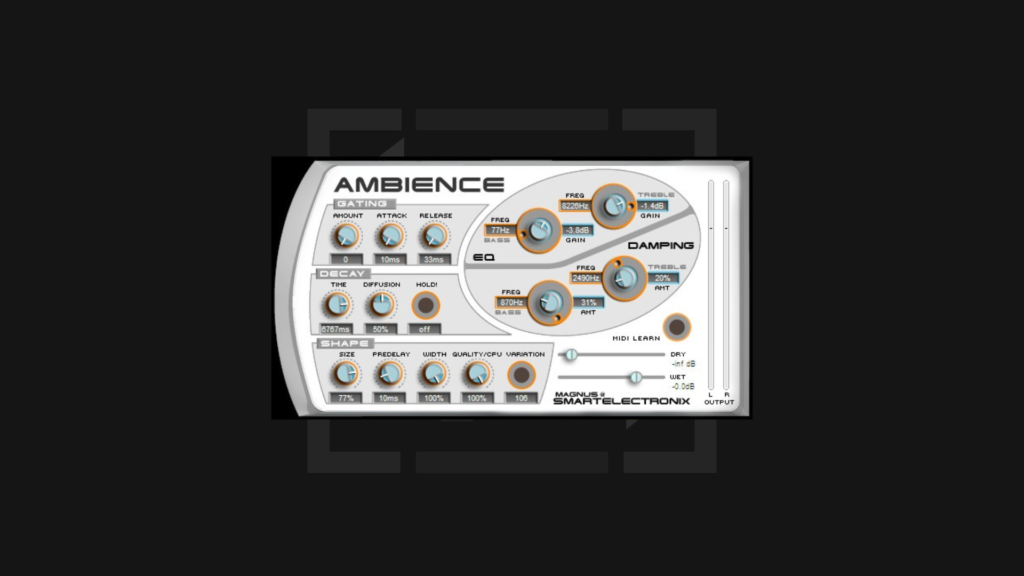
| Main features | Dry/wet gain, reverb time and room size, pre-delay, width, damping, diffusion, EQ, variation, Gater, Hold and presets. |
| Windows format | Legacy VST, documented as 32-bit by the distributor. |
| macOS formats | Historical Audio Unit variants, with 32- and 64-bit support listed. Modern host and operating-system behaviour is not established. |
| VST3 / native Apple Silicon | Not documented for this legacy release. Do not assume support. |
| Best reason to try it | Creative gating and held reverb tails, particularly for percussive electronic sound design. |
| Primary download | Ambience at Plugin Boutique (free listing). |
The distributor’s product information and system requirements are the best immediate reference for the available packages. The link above retains Underground Talent’s existing affiliate tracking; any eligible referral may help support our work at no additional charge. Check the displayed terms before download.
What is Ambience by Smartelectronix?
Ambience is a traditional reverb effect built around simulated reflections and a decaying reverberant field. A reverb makes a dry sound seem to occupy a space, but it can also transform a simple hit into a broad cloud of sound. In dance music, that second use is often more interesting than realism.
Magnus’s Ambience dates back to the early 2000s. In a 2010 Rekkerd report, the reverb was noted as available in a nag-free donationware edition. Its controls were already familiar to producers who wanted more than a basic room preset: a diffusion control, flexible filtering, a way to vary the room, a dynamics-driven gate and a reverb-freeze function.
It should not be confused with OTODESK Ambience, a separate free Windows VST3 released in 2026, or with Audio Modeling’s Ambiente. These are different developers and different products. As Bedroom Producers Blog reported in June 2026, OTODESK’s plugin is a newer feedback-delay-network design; this article is about the older Smartelectronix effect.
Ambience’s main controls explained
You do not need to memorise every knob before making a sound. Start with the length and size of the space, then shape the frequency response and finally experiment with Gater and Hold. The precise result depends on the source, the preset and the version running in your DAW.
Time, Size and Pre-delay
Time controls how long the reverberation takes to die away. Shorter times keep percussion more localised; longer times can turn a stab into a dense atmosphere. Size changes the perceived dimensions of the simulated space. A small room with a very long tail can sound deliberately unnatural, which may be perfect for a processed techno texture but less convincing for acoustic realism.
Pre-delay separates the direct hit from the first apparent reflections. A little pre-delay lets the transient of a clap or synth stab remain intelligible while the wash arrives behind it. It is not the same as the reverb’s full decay time, and it need not be synchronised exactly to the track’s tempo.
Dry, Wet and Width
The Dry control sets the direct signal level, and Wet sets the reverberant level. On an insert you normally want some of each; on a dedicated return channel, the standard starting point is fully wet with no direct sound from the return. Plugin Boutique’s instructions specifically recommend reducing Ambience’s Dry control to minus infinity when used as a send effect.
Width affects the stereo image of the processed space. Keep an ear on mono compatibility and the mix’s centre of gravity. A huge, wide tail can make a sparse synth sound powerful in isolation while covering a kick, bass or lead in the full arrangement.
Damping, EQ and Diffusion
Damping changes how the high and low parts of a reverb fade; real rooms rarely let every frequency ring equally long. Ambience also offers an EQ section, useful for removing muddy low frequencies from the processed sound. Diffusion affects the density and character of the reflections and is particularly noticeable on smaller spaces.
If the reverb sounds cloudy, try reducing the wet level, shortening the tail and cutting lows from the effect before inserting more processors. A carefully filtered short space is often more useful on drums than a giant full-band hall.
Gater: rhythmic reverb without a permanently washed-out mix
The Gater section can make the reverb react to the dynamics of the input. Unlike a natural room, it can reduce or shape the tail around the source’s activity. That makes it interesting for hard kicks, claps, rimshots and syncopated loops where uncontrolled reverb would soften the rhythm.
This is a creative effect, not a promise of a perfect tempo-synchronised trance gate. Start with a modest tail and adjust the gate by ear until the next hit has space to arrive.
Hold: freeze the reverb into a sustained texture
Pressing Hold freezes the current reverb field until the function is released. Instead of simply increasing decay, it keeps the generated sound alive. Trigger it on a percussive transient, bright chord or metallic stab and you can turn a momentary event into something approaching a drone or pad.
The distributor describes this as a core creative function. Unlike an ordinary long decay, Hold can sustain a particular moment in the effect’s output. Combining it with the Gater can create moving textures whose level follows new input activity. Automating the switch may be possible depending on how the host exposes the plugin’s parameters; do not assume every old host/build exposes identical automation controls.
Variation, presets and quality
The Variation function alters the simulated room’s behaviour without forcing you to rebuild every setting from scratch. It can be useful when a setting produces an awkward metallic resonance. The included presets provide a quick introduction to the plugin’s range; use them as starting points rather than finished mixing decisions.
The Quality control trades processing demand against the character and resolution of the effect. Increase it when the machine has enough headroom, but evaluate the result in the actual mix. An old plugin’s performance on a modern computer depends as much on hosting and bridging as on the reverb algorithm itself.
Four ways to use Ambience in techno production
The following recipes are creative starting points, not official factory presets or values measured in a test. Tweak them by ear and record a comparison with the effect bypassed.
1. Give a clap an old-school gated tail
- Place Ambience on an auxiliary return if your host supports the plugin reliably.
- Send a clap or snare to the reverb and set the return predominantly wet.
- Begin with a relatively short decay and moderate perceived room size.
- Use Gater to shape the tail so the ambience supports the rhythmic hit without masking the following kick.
- Reduce unnecessary low-frequency energy in the effect and check the pattern alongside the entire drum group.
The aim is not necessarily a realistic snare room. It is a controlled explosion of space that stops feeling louder than the transient.
2. Turn a metallic hit into a moving atmosphere
- Choose a resonant percussion sample, noise burst or short FM stab.
- Use a long decay and experiment with Size and Variation.
- Trigger Hold once an interesting reverb texture develops.
- Record the resulting return as audio if you need reproducible results across computers or DAW versions.
- Process that audio further with filtering, subtle modulation or rhythmic chopping.
Resampling is particularly sensible with a legacy plugin: you keep the creative result without depending on the same binary being available ten projects later.
3. Add depth to dub-techno chords
Send a restrained amount of a short chord stab to a darker, longer reverb. Use damping and EQ to prevent the tail from fighting the bass. Experiment with pre-delay so that the chord’s attack stays forward. Automate the send amount across a phrase rather than covering every stab in the same amount of space.
4. Build a transitional swell from one sound
Freeze a short source with Hold, capture it as audio and reverse or fade the recording into the next section. Add a deliberate cutoff or rhythmic gate at the transition. This creates a clear arrangement gesture without needing the rest of the track to live inside a long reverb tail.
Want to expand these ideas? Read our guide to techno styles and their sonic differences and our guide to room acoustics for a deeper understanding of how real spaces and artificial effects shape what we hear.
Where to download Ambience VST safely in 2026
The verified storefront is Plugin Boutique’s Ambience product page. The listing was still live when checked for this update and showed the plugin as FREE, with an account login required to download. Open the product page, read the current requirements, then obtain the installer or archive through your own account.
We also checked KVR’s Ambience directory entry, which retains historical version, platform and user-review information. KVR and the long-running Plugins4Free listing are useful for checking the plugin’s history, but prefer the documented retailer or developer distribution rather than unrelated download mirrors.
The old Magnus/Smartelectronix developer URL referenced by older articles could not be reliably inspected during this audit. We therefore are not representing it as a current working official download. Avoid random “64-bit updates”, modified DLL packages or unofficial installers that make unsupported compatibility promises.
Will Ambience work on Windows 10/11, macOS or your DAW?
There is no reliable universal yes. Think in terms of operating system + CPU architecture + plugin architecture + host support. A plugin listed as compatible with Windows or macOS many years ago is not automatically compatible with current releases of those platforms.
| System / workflow | What to know before downloading |
|---|---|
| Windows, modern 64-bit DAW | Plugin Boutique lists the Windows download as 32-bit VST. A 64-bit host may not load it natively; third-party bridging can add complexity and instability. |
| Ableton Live 10, 11 or 12 on Windows | Ableton’s own documentation says 64-bit plugins only. The advertised 32-bit Windows Ambience build is not a direct modern Live installation. |
| Mac with an older Intel environment | Historical AU builds included 64-bit support, but verify against the exact host and macOS version. |
| Current Apple Silicon Mac | No verified native Apple Silicon build. Do not assume that Rosetta or an older AU will work correctly in your host. |
| Logic Pro on current macOS | Logic requires a compatible Audio Unit. Historical AU availability does not establish compatibility with current Logic; an older distributor listing expressly warns about Logic support. |
| VST3-only workflow | No Smartelectronix Ambience VST3 build was established from the verified sources. |
The official Ableton Windows VST instructions clearly distinguish VST2 DLL files from VST3 files and warn that only 64-bit plugins can run in current Windows Live versions. An unreliable legacy plugin should not become a single point of failure in an important session.
How to install the Windows version when you have a compatible host
- Download the Windows archive from the verified listing and read its supplied README.
- Confirm your DAW can load a 32-bit VST2 plugin. Many current DAWs cannot do so directly.
- Place the extracted
Ambience.dllin a dedicated VST2 folder recognised by the compatible host. Do not put the DLL in a VST3 folder. - Enable or scan that VST2 folder in the host’s plugin preferences, then restart or rescan as required.
- Open a disposable test project first. Verify the interface, audio processing, preset recall and project reopen before depending on the effect in production.
How to install the historical Mac Audio Unit, if compatible
For a Mac package containing Ambience.component, the typical system-wide Audio Units location is /Library/Audio/Plug-Ins/Components/. This is not the same as the VST folder. Follow the archive’s README and the host’s installation guidance. Then rescan Audio Units and test in an empty project. Do not bypass macOS security warnings just to make an unsigned or incompatible legacy binary load.
Our general VST installation guide covers common plugin folders and rescanning, but the architecture limitations above take precedence for this specific effect.
Ambience does not appear or crashes: what to check
- Wrong architecture: a 32-bit DLL will not become a 64-bit VST simply because it is placed inside a modern host’s folder.
- Wrong format path: keep VST2 and VST3 folders separate. Audio Units belong in their Mac component folders.
- Host cache: close and reopen the DAW or trigger its documented plugin rescan after installation.
- Saved presets: test whether the plugin recalls every parameter after you save, close and reopen a project. Older community reports disagree about reliability in particular REAPER configurations.
- Unexpected CPU load: a bridging layer can be more demanding than expected. A modern equivalent may be more reliable than spending hours debugging.
- Mac validation: historical macOS binaries can fail current code-signing, architecture or Audio Unit validation requirements.
Make a backup of a valuable project before inserting unfamiliar legacy plugins. Once you find a usable sound, record or freeze the processed audio. Treat the plugin as an optional instrument for sound design, not a permanent dependency you cannot remove.
Is Ambience better than today’s free reverb plugins?
There is no objective winner across every sound and mix. Ambience’s appeal is the character of its reverb and the unusual Hold/Gater combination. Modern free alternatives, however, have a major practical advantage: current architecture support and active developer documentation.
| Plugin | Strength | Compatibility consideration |
|---|---|---|
| Ambience by Smartelectronix | Old-school character, gated reverb, frozen tails and quick sound-design surprises. | Legacy Windows 32-bit VST; historical Mac AU. Verify before use. |
| Valhalla Supermassive | Huge modulated reverbs, delays and slowly evolving spaces. | Developer documents current 64-bit Windows and native Intel/Apple Silicon Mac builds. |
| Kilohearts Essentials Reverb | Simple general-purpose spatial effects within a maintained free toolkit. | Part of an actively updated Mac/Windows installer and free Essentials collection. |
If you are on a current 64-bit setup and simply want a lush, reliable free atmospheric reverb, Valhalla Supermassive is the easier first recommendation. If you already have a compatible old machine or particularly like Ambience’s gated and frozen tails, the classic Smartelectronix release remains musically interesting. This is a workflow comparison, not a claim that one algorithm is universally higher quality.
For a different kind of free sound-making, see our Dexed FM synth guide. A simple FM stab through a carefully gated reverb is still an effective starting point for a rough, resonant techno texture.
Underground Talent verdict: a classic worth knowing, with conditions
Ambience deserves to be remembered for what it brought to the freeware scene: controllable space, interesting dynamics and a reverb-freeze feature that can turn ordinary source material into an evolving sound. It is more rewarding when treated as a sound-design instrument than as a miracle solution for every mix.
But the modern recommendation must be honest. It is free and still listed for download; it is not confirmed as a contemporary plug-and-play choice. The Windows package is documented as 32-bit, and the historical Mac release needs host-specific compatibility checks. That limitation matters more than another paragraph comparing it to unnamed premium products.
Download: Smartelectronix Ambience at Plugin Boutique (free listing; login required). If your DAW cannot host it, consider Valhalla Supermassive instead.
Ambience VST FAQ
Is Ambience by Smartelectronix still free?
Yes, the Plugin Boutique listing was marked free when checked on 31 October 2026. Download access requires logging in, and the site’s terms may change.
Is there a 64-bit Windows Ambience VST?
The verified Plugin Boutique product requirements list the Windows edition as a 32-bit VST. We did not verify an official, current 64-bit Windows build of this specific Smartelectronix plugin. Avoid assuming that a third-party repackaged DLL is an official upgrade.
Does Ambience come in VST3 format?
The documented Smartelectronix download is a legacy VST on Windows and an older AU package on Mac. We did not establish a VST3 version for this plugin. Do not confuse it with OTODESK’s newer, unrelated Ambience VST3.
Does Ambience work with Ableton Live 12?
Not directly on Windows using the distributor’s 32-bit VST build: Ableton Live 12 supports 64-bit plugins only. We did not test the historical Mac AU version in Live 12, so compatibility on Mac remains unconfirmed.
Can I use Ambience in Logic Pro?
A Mac Audio Unit build existed historically, but that is not proof it will run in the current Logic Pro or on Apple Silicon. Some old reseller information explicitly lists Logic as unsupported. Test the precise combination before trusting a production session.
What makes Ambience different from a basic reverb?
Beyond time, size and tone shaping, its Gater section can give tails a rhythmic character, while Hold can sustain a captured reverb texture. These are useful creative features for techno, ambient and experimental electronic production.
Sources and version notes
- Plugin Boutique: Ambience product description, features and system requirements (verified listing and download availability).
- KVR Audio: Ambience entry and historical user reviews (legacy platform information and user experience, not modern test certification).
- Rekkerd: Ambience nag-free edition and features, 26 July 2010 (historical context).
- Ableton: Using VST plugins on Windows (current host architecture and installation guidance).
- Valhalla DSP: Supermassive product specifications and Kilohearts: Essentials (current free alternatives).
- Bedroom Producers Blog, June 2026: OTODESK Ambience (distinguishes an unrelated new same-name plugin).
Editorial policy: Platform claims describe published support and available downloads, not a lab test by Underground Talent. If the vendor publishes new native builds, the compatibility section should be checked again before changing it.